
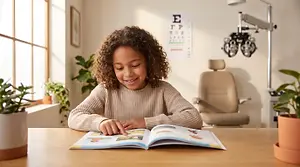
School Is Back—But Is Your Child’s Vision Ready to Learn?
Now that classes are underway, your child is using their vision all day long. They shift their focus from a nearby worksheet to the board, follow lines of print, write, use a computer, complete homework, play sports, and watch classroom demonstrations. When a visual skill is not working comfortably, all that effort can make school feel harder than it needs to.
September gives parents a useful chance to ask: What am I noticing now that school has started? A child who seemed fine during summer may show new difficulties once reading, screen use, and homework increase. Because children do not always know what normal vision should feel like, they may not say that anything is wrong.
Signs Your Child May Be Struggling to See Comfortably
A vision concern does not always look like obvious blur. Watch for patterns such as:
- Squinting to see the board or distant signs
- Frequent headaches after school or homework
- Rubbing their eyes or saying their eyes feel tired
- Holding books, tablets, or phones very close
- Losing their place, skipping words, or using a finger while reading
- Avoiding homework, reading, or other close-up tasks
- Covering or closing one eye
- Sitting unusually close to a screen
- Showing a change in concentration, classroom participation, or confidence
These signs do not prove that a child has a vision problem. However, persistent changes deserve investigation. What appears to be an academic, attention, or behavioural issue can sometimes have a visual component. A timely exam may identify an obstacle that can be addressed.
Why a School Screening Is Not the Same as an Eye Exam
School screenings are useful for flagging some possible concerns, but they are not a replacement for a comprehensive eye exam. A child may pass a screening and still have difficulty with the visual skills needed for comfortable reading and classroom work.
During a comprehensive exam, the eye doctor can evaluate more than how clearly your child reads letters at a distance. The assessment may include prescription needs, focusing, eye teaming, tracking, depth perception, and overall eye health. Looking at both eyesight and visual function gives families a more complete picture of how a child’s eyes are supporting learning.
Do Their Current Glasses Still Work Well?
Children grow quickly, and their vision can change along with them. If your child already wears glasses, notice whether they are squinting again, looking over the lenses, reporting headaches, or moving closer to see. Frames can also become tight, crooked, loose, or too small, affecting comfort and how well the lenses sit in front of the eyes.
An updated prescription and properly fitted children’s eyeglasses can help your child see comfortably throughout the school day. If nearsightedness is increasing, families can also ask whether myopia management may be appropriate instead of only updating the prescription.
Help Remove a Visual Barrier to Learning
If your family skipped an eye exam before school began, it is not too late. In fact, the first few weeks of class may reveal useful clues that were not apparent during summer. Bring any teacher observations, examples of homework struggles, and your child’s current glasses to the visit.
Blue Valley Vision of Overland Park provides comprehensive family and pediatric eye care for children in Overland Park and nearby communities. The goal is to understand how well your child sees, how their eyes work together, and whether their eye health or prescription needs attention.
Clear, comfortable vision cannot guarantee school success, but it can remove an unnecessary obstacle to reading, participation, and confidence. If you have noticed new difficulties since classes started, request an appointment for your child’s comprehensive eye exam today.